PAM-2500
Version:
High-performance Field and Laboratory Chlorophyll Fluorometer


The Fastest Portable PAM Fluorometer
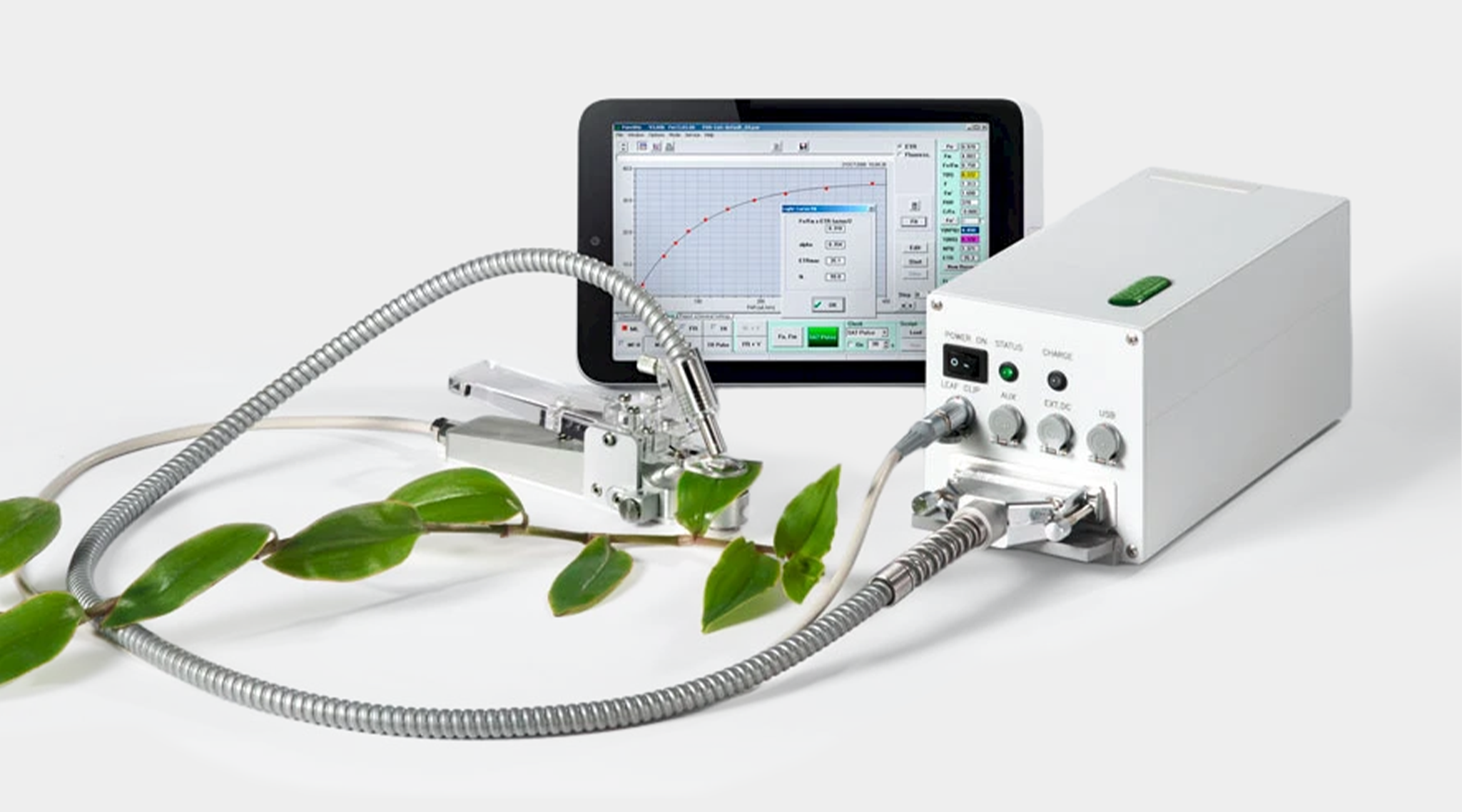
The PAM-2500 is a high-performance portable chlorophyll fluorometer that combines saturation pulse analysis with fast chlorophyll fluorescence kinetics in a single, compact instrument. Continuing the line of portable PAM fluorometers that started in the 1990s with the well-known PAM-2000/2100, the PAM-2500 has been completely newly developed using state-of-the-art technology. With a time resolution of 10 µs, it is the fastest portable PAM fluorometer available - capable of resolving the complete polyphasic fluorescence rise (OJIP) that occurs within the first second after onset of illumination.
This dual capability makes the PAM-2500 uniquely versatile: from standard FV/FM measurements and light response curves to detailed analysis of electron transport steps via OJIP fluorescence kinetics all in one field-portable device.
What is OJIP?
When a dark-adapted leaf is exposed to a strong light pulse, chlorophyll fluorescence rises from a minimum (Fo) to a maximum (Fm) within approximately one second. This rise is not smooth — it follows a characteristic pattern with distinct steps known as O, J, I, and P (also denoted Fo, I1, I2, and Fm):
O (F0) — the initial fluorescence level, all PSII reaction centers open
J (I1) — first inflection at ~2 ms, related to the reduction of the primary electron acceptor QA
I (I2) — second inflection at ~30 ms, related to the filling of the plastoquinone pool
P (Fm) — the peak, all PSII reaction centers closed
Each step reflects a specific stage in the photosynthetic electron transport chain. The shape and timing of the OJIP curve provide detailed information about the functional state of photosystem II, the electron transport capacity, and the overall vitality of the photosynthetic apparatus - going well beyond what a simple FV/FM measurement alone can reveal.
Powerful Optics in a Compact Housing
All optical and electronic components fit in a housing of just 23 × 10.5 × 10.5 cm. High-performance power LEDs deliver actinic light up to 4,000 µmol m⁻² s⁻¹ and single-turnover flashes up to 125,000 µmol m⁻² s⁻¹ enabling quasi-rectangular light pulses essential for accurate fast chlorophyll fluorescence kinetics. A strong far-red LED allows specific PSI excitation for F0' determination.
Leaves, Suspensions, and Everything in Between
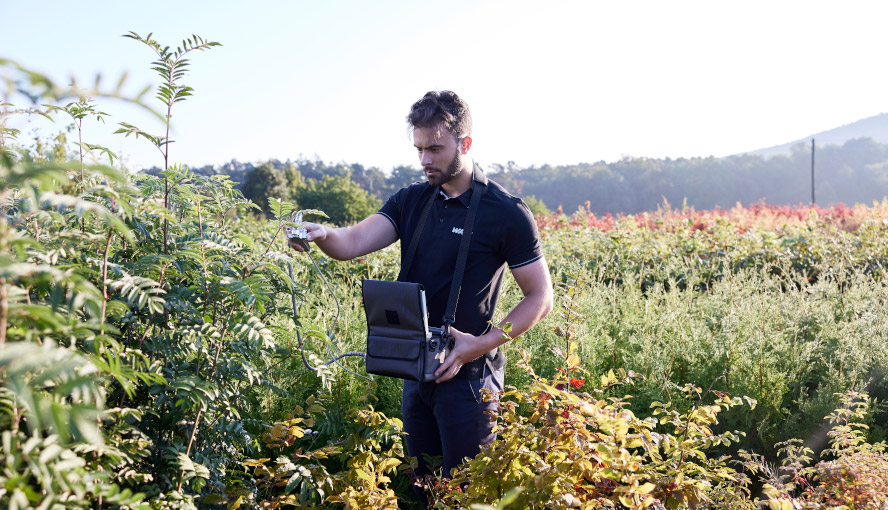
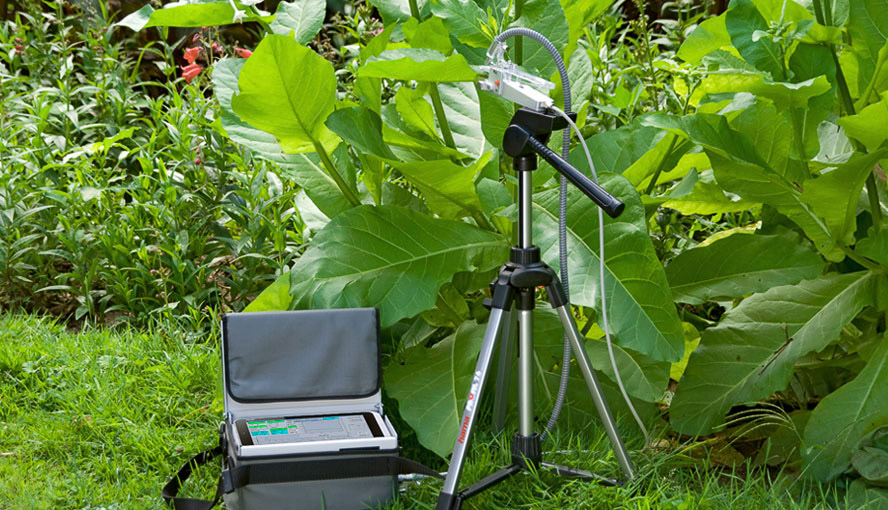
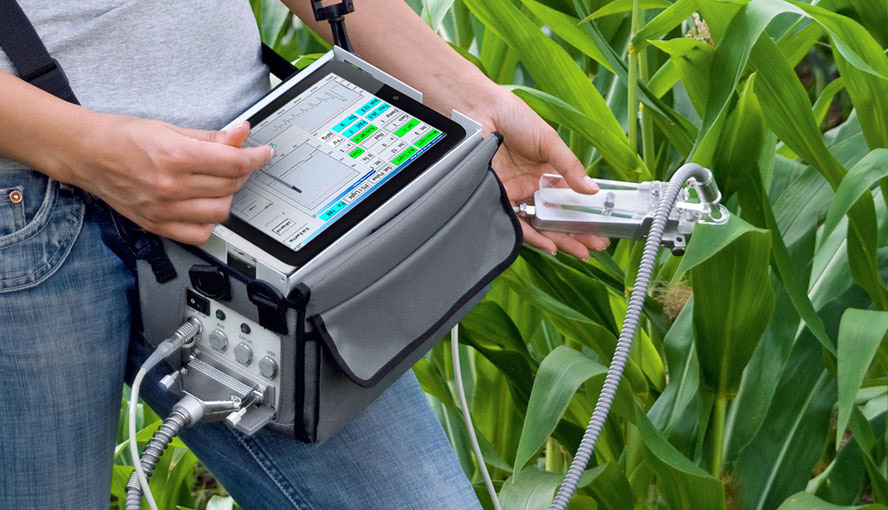
The PAM-2500 adapts to different sample types via a flexible fiberoptics system that guides modulated measuring light and actinic light to the sample, and collects the chlorophyll fluorescence. For leaf measurements, the 2030-B leaf clip provides simultaneous PAR and temperature sensing, permitting derivation of relative electron transport rates (ETR) from ambient PAR and PSII photochemical yield Y(II). For algae and cyanobacteria suspensions, the KS-2500 cuvette with magnetic stirrer and optional temperature control enables precise laboratory measurements. Blue actinic light up to 800 µmol m⁻² s⁻¹ is available for samples where blue excitation is preferred.
Software and Connectivity
The PamWin-4 software runs on Windows PCs or the ultra-mobile UMPC-8 tablet, connected via Bluetooth for cable-free field operation. A dedicated outdoor interface - derived from the proven PAM-2000/2100 software - provides streamlined controls for rapid measurements in the field, while the full software offers comprehensive analysis tools for saturation pulse analysis, light curves, induction curves, and OJIP fluorescence recordings.
What Sets the PAM-2500 Apart
Fastest Portable PAM Fluorometer: 10 µs time resolution for OJIP fast kinetics and saturation pulse analysis in one device.
From Leaves to Suspensions: Flexible fiberoptics system with leaf clips for field measurements and cuvette for algae and cyanobacteria in the lab.
Red, Blue, and Far-Red Light: Three independent LED sources for actinic illumination, single-turnover flashes up to 125,000 µmol m⁻² s⁻¹, and specific PSI excitation.
Combined OJIP and PAM Analysis: Full saturation pulse quenching analysis plus polyphasic fluorescence rise kinetics - both methods, one instrument.